Living Resource · The Archive
THE ARCHIVE
Kings and queens they left out of the textbooks. Kemetic teachings older than empire. Inventors whose names were buried with their patents. This is the record they didn't want you to keep.
Section · 01
Kings & Queens
Twelve African sovereigns whose reigns shaped continents but whose names were quietly filed out of Western history books. Sources: Britannica, Smithsonian, British Museum, Met Museum, UNESCO.
- 01
Mali Empire, West Africa · c. 1280–1337 CE (reigned c. 1312–1337)
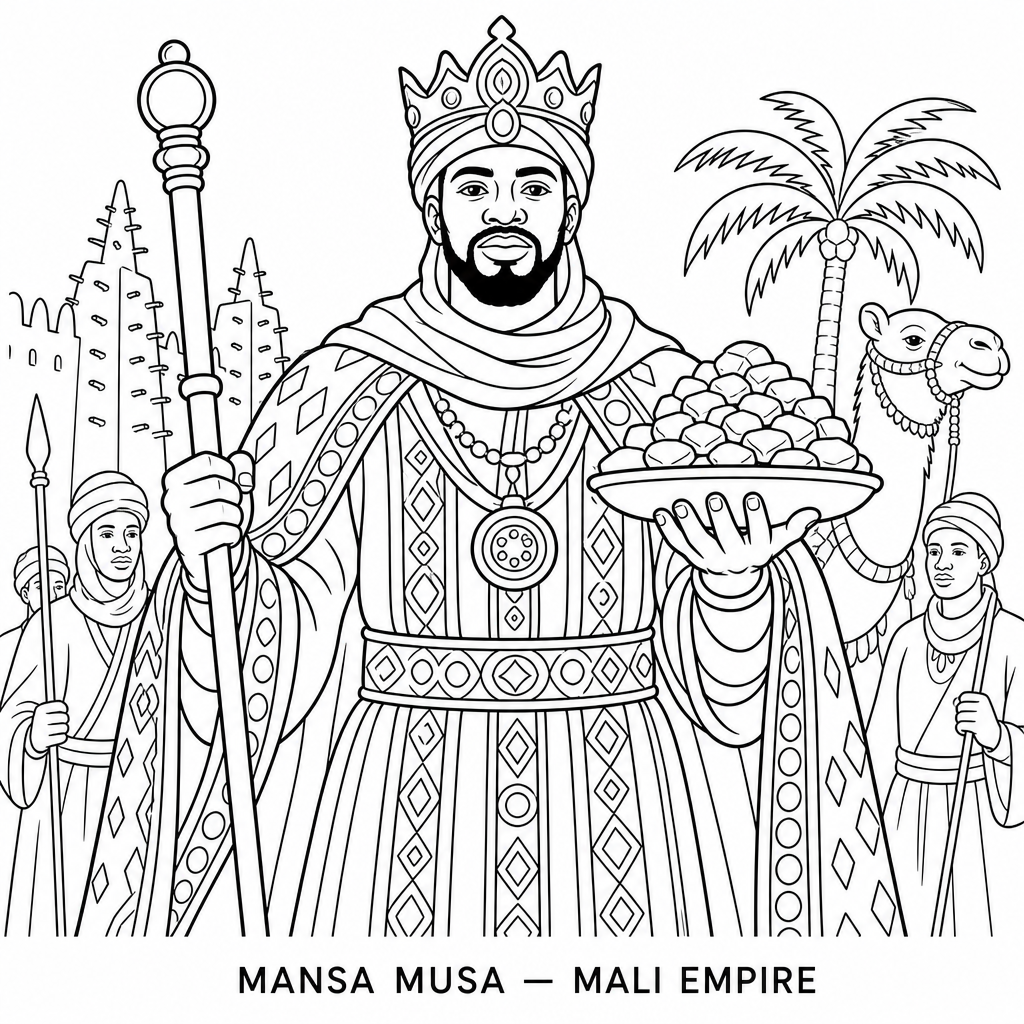
Mansa Musa
Mansa Musa was the tenth ruler of the Mali Empire, which at its height covered much of West Africa and controlled lucrative gold and salt trade routes. He is widely regarded as one of the wealthiest individuals in recorded history due to his control of nearly half the world's gold supply at the time. His 1324 pilgrimage to Mecca, during which he reportedly distributed so much gold that he disrupted currency values in Cairo for years, brought Mali international fame. He also transformed Timbuktu into a major center of Islamic learning, commerce, and architecture, funding mosques like Djinguereber.
Why erasedDespite ruling one of the richest and most cosmopolitan empires of the medieval world, Mansa Musa is largely absent from standard Western world-history curricula, which tend to center European medieval kingdoms as the era's benchmark of power and wealth.
- 02
Ndongo and Matamba, present-day Angola · c. 1583–1663 CE
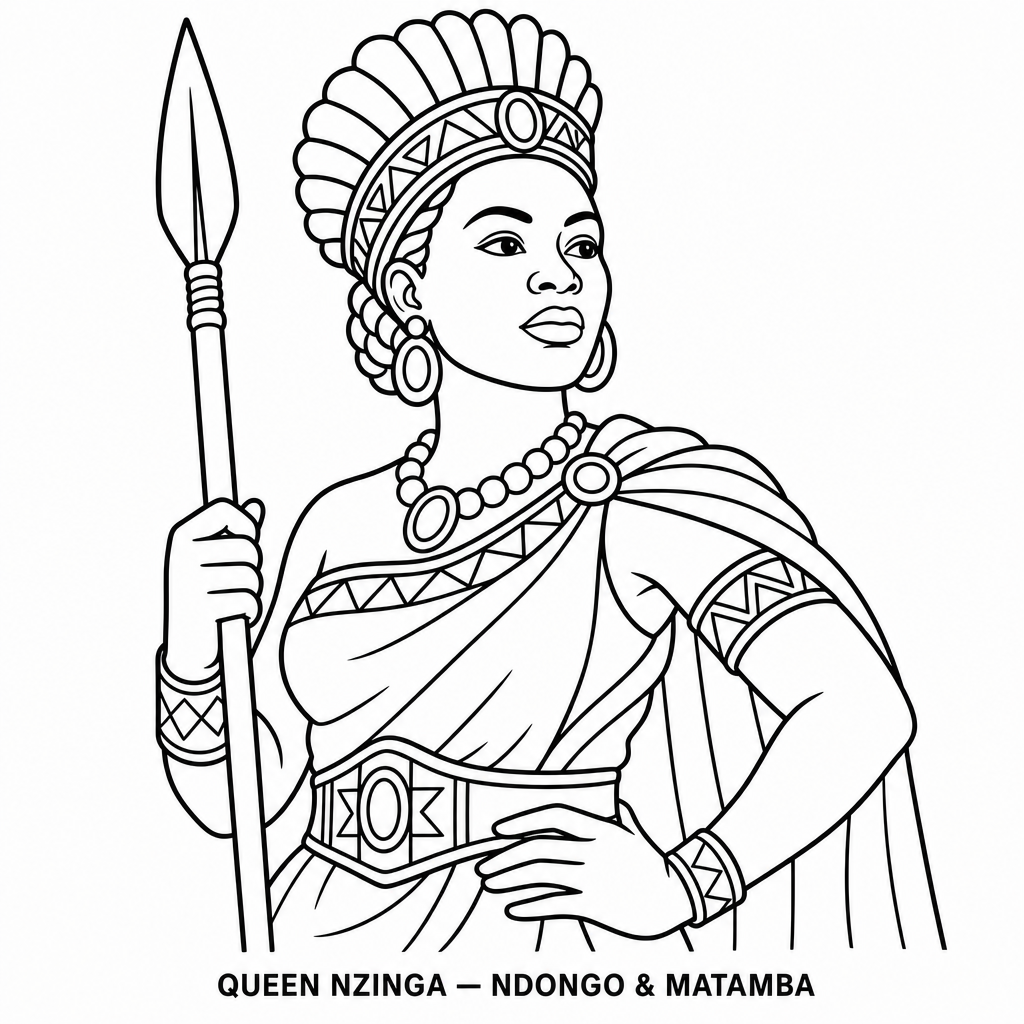
Queen Nzinga of Ndongo (Njinga Mbandi)
Njinga Mbandi ruled the Ndongo and Matamba kingdoms and led decades-long military and diplomatic resistance against Portuguese colonial expansion and the transatlantic slave trade. She skillfully used alliances, including with the Dutch, and converted to Christianity strategically to negotiate power. She personally led troops into battle well into her sixties and built Matamba into a haven for escaped slaves. Her reign is one of the longest-documented resistances to European colonization in Africa.
Why erasedHer decades of successful resistance to Portuguese colonization complicate simplistic Western narratives of African passivity during the slave-trade era, which is why her story receives little attention in most textbooks.
- 03
Kingdom of Kush (Meroë), present-day Sudan · c. 60–10 BCE
Queen Amanirenas of Kush
Amanirenas was a Kandake (queen or queen mother) of the Kingdom of Kush who led Kushite forces against the Roman Empire after Rome annexed Egypt. She commanded a campaign that sacked Roman garrisons at Aswan and famously brought back a bronze head of Emperor Augustus as a war trophy, burying it beneath the steps of a Meroitic temple as a symbol of dominance. Ancient accounts, including Strabo's, describe her as a formidable one-eyed warrior queen. She ultimately negotiated a favorable peace treaty with Rome around 21–20 BCE.
Why erasedAs an African monarch who fought Rome to a negotiated standstill, her story challenges Eurocentric narratives that cast Rome as unopposed in its expansion, contributing to her exclusion from mainstream classical history education.
- 04
Egypt (New Kingdom, 18th Dynasty) · c. 1507–1458 BCE (reigned c. 1479–1458 BCE)
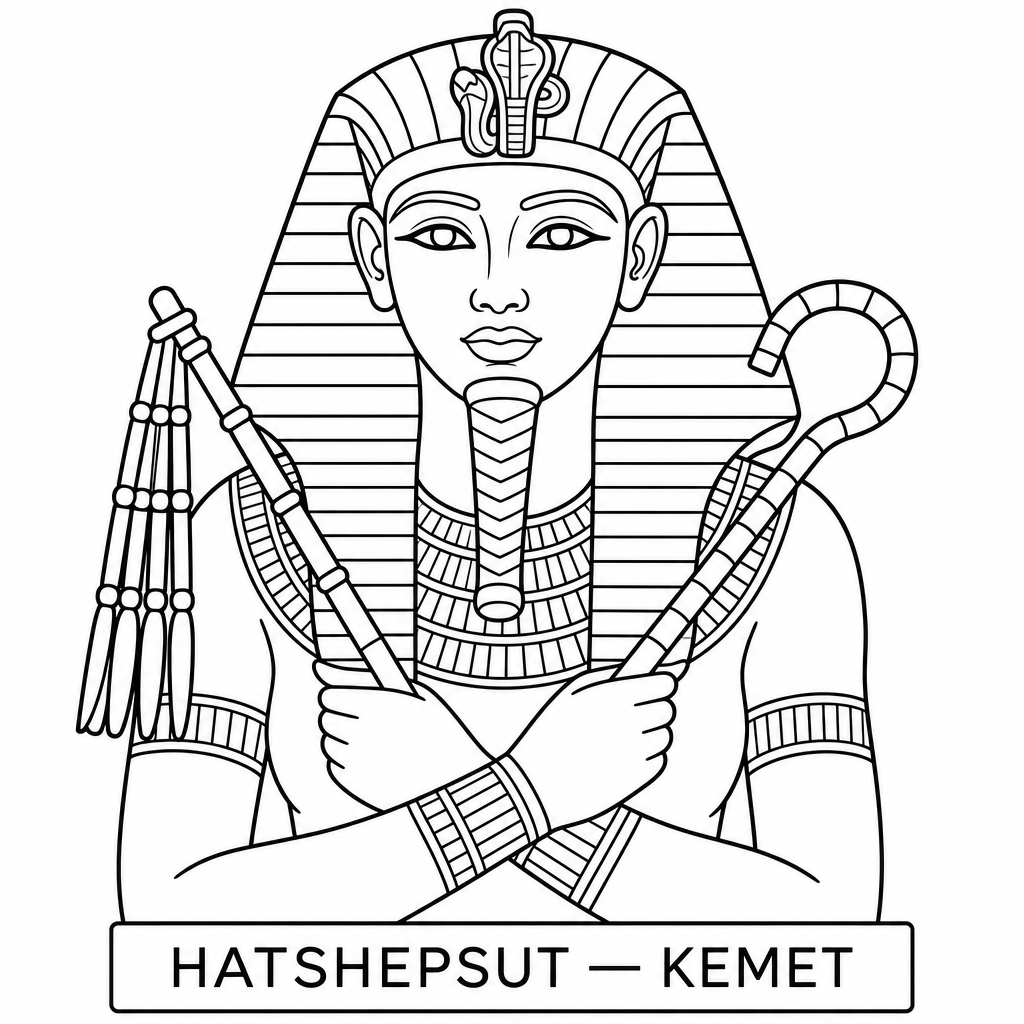
Hatshepsut
Hatshepsut was one of the few female pharaohs to rule Egypt with full royal authority, often depicted in traditional male pharaonic regalia including the false beard. Her reign was marked by extensive building projects, most notably her mortuary temple at Deir el-Bahari, and successful trade expeditions to the Land of Punt. She stabilized and expanded Egypt's economy through trade rather than conquest. After her death, later pharaohs attempted to erase her monuments and name from official records.
Why erasedAncient efforts to erase her from the historical record were compounded by later Western Egyptology's tendency to minimize female political power, keeping her largely absent from general history education outside specialist study.
- 05
Kingdom of Kush (Napata), founder of Egypt's 25th Dynasty · c. 8th century BCE (reigned c. 744–714 BCE)
Piye (Piankhi)
Piye was a Kushite king from Napata (in present-day Sudan) who conquered Upper and Lower Egypt, founding the Twenty-fifth Dynasty of Egypt, often called the 'Nubian' or 'Black Pharaoh' dynasty. He presented himself as a restorer of traditional Egyptian religious order after a period of political fragmentation. His victory stela at Gebel Barkal is one of the most detailed royal inscriptions from ancient Africa, describing his campaign in vivid narrative form. His dynasty ruled Egypt for roughly a century.
Why erasedThe fact that Kushite (Nubian) kings ruled Egypt is frequently omitted or minimized in Western textbooks that present ancient Egypt in isolation from its African context.
- 06
Kingdom of Kush and Egypt (25th Dynasty) · c. 690–664 BCE
Taharqa
Taharqa was one of the most powerful pharaohs of Egypt's 25th (Kushite) Dynasty, ruling over an empire stretching from Sudan to the Levant. He undertook massive building programs, including additions to the Temple of Karnak, and is mentioned in the Hebrew Bible (2 Kings 19:9) in connection with conflicts against the Assyrian Empire. His reign faced sustained military pressure from Assyria, which eventually invaded Egypt. He is depicted in numerous surviving statues showing distinctly Nubian features and royal regalia.
Why erasedTaharqa's prominence as an African pharaoh referenced even in biblical text is rarely highlighted in Western religious or historical education, which tends to sideline Kushite contributions to the ancient Near East.
- 07
Benin Empire, present-day Nigeria · c. late 15th–early 16th century CE
Queen Idia of Benin
Idia was the Iyoba (Queen Mother) of the Benin Empire and mother of Oba Esigie. She played a crucial military and political role in helping her son secure and defend the throne against rival claimants and invading forces, reportedly using strategic and spiritual counsel. Her image was later immortalized in a famous ivory pendant mask, now among the most iconic African artworks in Western museum collections. The role of Iyoba was formally established as a powerful court position partly because of her legacy.
Why erasedThough her ivory mask is a globally recognized artifact (looted in the 1897 British punitive expedition), her personal history and political significance are rarely taught alongside the artifact in Western institutions that display it.
- 08
Ashanti Empire, present-day Ghana · c. 1840–1921 CE
Yaa Asantewaa
Yaa Asantewaa was the Queen Mother of Ejisu in the Ashanti Empire who led the 1900 War of the Golden Stool, a major armed rebellion against British colonial rule. When male Ashanti leaders hesitated to fight after the British demanded the sacred Golden Stool, she rallied and personally led an army of thousands. Though the rebellion was ultimately suppressed and she was exiled, it was one of the last major wars of African resistance against colonization on the continent. She remains a celebrated symbol of anti-colonial resistance and female leadership in Ghana.
Why erasedAs a woman who led a large-scale armed rebellion against a European empire, her story disrupts colonial-era narratives that framed African resistance as minimal or male-only, contributing to her marginalization in Western curricula.
- 09
Ethiopian Empire · 1844–1913 CE (reigned 1889–1913)
Menelik II
Menelik II was Emperor of Ethiopia who modernized the country's infrastructure, military, and administration while expanding its territory. He is best known for leading Ethiopian forces to a decisive victory over Italy at the Battle of Adwa in 1896, preserving Ethiopian sovereignty and making it the only African nation to successfully repel a European colonial invasion during the Scramble for Africa. This victory made Ethiopia a global symbol of Black self-determination. He also founded the modern capital, Addis Ababa.
Why erasedThe Battle of Adwa is a pivotal event proving African military and political capability against European imperialism, yet it receives minimal coverage in Western accounts of the colonial era.
- 10
Zulu Kingdom, present-day South Africa · c. 1787–1828 CE (reigned 1816–1828)
Shaka Zulu
Shaka kaSenzangakhona transformed the small Zulu clan into a powerful centralized kingdom through sweeping military, social, and political reforms. He is credited with revolutionary military tactics, including the short stabbing spear (iklwa) and the 'buffalo horn' encirclement formation, which reshaped warfare across southern Africa. His consolidation of power triggered the Mfecane, a period of major regional upheaval and migration. His administrative innovations laid the foundation for the Zulu Kingdom's later resistance to British colonization.
Why erasedWhile often sensationalized in Western media as purely a brutal warlord, his sophisticated state-building and military innovation are rarely presented with the nuance given to European military strategists in mainstream education.
- 11
Blue Mountains, Jamaica · c. 1686–c. 1755 CE
Queen Nanny of the Maroons
Nanny was a leader of the Windward Maroons, communities of formerly enslaved Africans who escaped Jamaican plantations and established independent settlements in the mountains. She is credited with organizing effective guerrilla resistance against British forces for decades, helping free hundreds of enslaved people and negotiate a 1740 peace treaty securing Maroon autonomy and land. Oral tradition and British military records both attest to her strategic and spiritual leadership within Nanny Town. She remains Jamaica's only female National Hero.
Why erasedAs an enslaved woman who successfully organized sustained armed resistance in the Americas, her leadership counters narratives that center enslaved people primarily as victims rather than active resisters, a framing largely absent from Western textbooks.
- 12
Mali Empire, West Africa · c. 1217–1255 CE (reigned c. 1235–1255)
Sundiata Keita
Sundiata Keita was the founder of the Mali Empire, uniting several Mandinka chiefdoms after defeating the Sosso king Sumanguru Kanté at the Battle of Kirina around 1235. His life and reign are preserved through the Epic of Sundiata, an oral tradition maintained by griots (Mande oral historians) that also encodes the Kurukan Fuga, an early charter outlining governance and social principles. Under his rule, Mali became a dominant regional power built on agriculture and control of trans-Saharan trade routes. His dynasty would later produce Mansa Musa.
Why erasedThe Kurukan Fuga is considered by some historians one of the earliest known constitutions, yet this is virtually unknown in Western political history education that credits constitutional traditions primarily to Europe.

Section · 02
Kemet Teachings
The spiritual system of ancient Kemet (Egypt): Ma'at, the Neteru, the Ankh, the Djed pillar, the 42 Negative Confessions, Ka/Ba/Akh, and more. Older than religion; a technology of alignment.
Ma'at
Ma'at refers both to a goddess and to the ancient Egyptian concept of cosmic order, truth, balance, justice, and harmony that governed the universe, society, and individual conduct. Pharaohs were understood to rule as agents responsible for upholding Ma'at against isfet (chaos or disorder). The concept permeated law, ethics, and religious ritual, and appears in the judgment of the dead, where the heart was weighed against the feather of Ma'at. It represented an integrated worldview linking personal morality to cosmic and social stability.
Modern applicationMa'at is often invoked today as a framework for personal integrity and social justice, encouraging individuals to align daily actions with truth, balance, and fairness.
The Neteru
Neteru (singular: Netjer) refers to the divine principles or forces personified as gods and goddesses in ancient Egyptian religion, such as Ra, Auset (Isis), Ausar (Osiris), and Djehuty (Thoth). Rather than being viewed strictly as separate deities in a Western polytheistic sense, some scholars and practitioners interpret the Neteru as aspects or attributes of a singular divine source expressed through nature and cosmic function. Each Netjer was associated with specific domains, symbols, and temples, and their myths encoded ethical, cosmological, and agricultural knowledge. Temple worship, festivals, and priesthoods were organized around honoring these forces.
Modern applicationMany modern spiritual practitioners study the Neteru as archetypes for self-reflection, meditating on qualities like wisdom (Djehuty) or motherhood/magic (Auset) as personal development tools.
The 42 Negative Confessions (Declarations of Innocence)
Found in the Egyptian Book of the Dead, the 42 Negative Confessions are a set of declarations recited by the deceased before a tribunal of 42 divine judges during the judgment of the soul, each addressing a specific sin the person claims not to have committed (e.g., 'I have not stolen,' 'I have not caused pain'). This ritual accompanied the weighing of the heart against the feather of Ma'at to determine the soul's worthiness for the afterlife. The confessions functioned as an ethical code reflecting Ma'at's values of honesty, restraint, and communal responsibility. They are documented on papyri and tomb inscriptions dating primarily to the New Kingdom period.
Modern applicationThe confessions are sometimes used today as a personal ethical checklist or meditation practice for self-examination and moral accountability.
The Kemetic Tree of Life
The Kemetic Tree of Life is a diagram, popularized in modern Afrocentric and esoteric literature, said to map the descent of the soul through stages of spiritual and physical development, sometimes correlated to Kemetic principles and later compared to the Hebrew Kabbalistic Tree of Life. Its historical basis in verified ancient Egyptian texts is debated among Egyptologists, with much of the specific diagrammatic form originating from 20th-century esoteric and Afrocentric writers rather than surviving pharaonic-era artifacts. Regardless of its exact historical provenance, it draws on genuine Kemetic themes of Ka, Ba, and spiritual ascension. It is presented in various practitioner traditions as a symbolic map for personal transformation.
Modern applicationPractitioners use the Tree of Life framework in meditation and self-development work as a symbolic guide for spiritual growth stages; note this concept is contested among historians and should be treated as a modern spiritual synthesis rather than a verified ancient artifact.
The Ankh
The Ankh is a cross-shaped symbol with a looped top that represented 'life' or 'the key of life' in ancient Egyptian iconography. It appears extensively in temple carvings, tomb art, and amulets, frequently held by deities such as Isis and Osiris to signify their power to grant life. It was also used in funerary contexts to symbolize eternal life and rebirth after death. Its exact origin is debated, with some scholars linking its shape to a sandal strap or a symbolic union of male and female principles.
Modern applicationThe Ankh is widely worn today as jewelry symbolizing vitality, spiritual connection, and cultural pride, particularly within African diaspora communities.
The Djed Pillar
The Djed pillar is an ancient Egyptian symbol depicting a column with several horizontal cross-bars, associated primarily with the god Osiris and representing stability, strength, and the backbone of Osiris himself according to myth. It featured in temple architecture, amulets, and the annual 'raising of the Djed pillar' ceremony, symbolizing renewal, resurrection, and the stability of kingship. The symbol connected agricultural fertility cycles (linked to Osiris as a god of vegetation) with cosmic and political order. It is one of the most enduring symbols in Egyptian funerary art.
Modern applicationModern practitioners sometimes use the Djed as a meditation focus for grounding, resilience, and rebuilding stability after hardship.
Ka, Ba, and Akh
In ancient Egyptian belief, the human being was composed of multiple spiritual aspects, with the Ka representing one's life force or vital essence created at birth, the Ba representing individual personality or soul that could travel between worlds (often depicted as a human-headed bird), and the Akh representing the transfigured, effective spirit achieved after successful passage through the afterlife judgment. Funerary rituals, offerings, and tomb architecture were designed to sustain the Ka and facilitate the Ba's journey so the deceased could become an Akh. This tripartite (and sometimes more elaborate) model of the soul reflects a sophisticated Egyptian theology of the self and afterlife.
Modern applicationThe Ka/Ba/Akh framework is used in modern spiritual teaching as a model for distinguishing vital energy, personality/soul, and higher enlightened consciousness in personal growth work.
Heru (Horus) vs. Set
The myth of Heru and Set narrates the conflict between Heru, son of Ausar (Osiris) and Auset (Isis), and his uncle Set, who murdered Ausar and usurped the throne, resulting in a prolonged struggle for legitimate kingship over Egypt. The myth concludes with Heru's eventual victory and rightful ascension, symbolizing the triumph of order, legitimate succession, and Ma'at over chaos and usurpation. Pharaohs were traditionally identified with Heru during their lifetime as the living embodiment of rightful rule. The myth also explains the symbolism of the Eye of Horus (Wedjat), representing healing and protection after Heru's eye was injured and restored in the conflict.
Modern applicationThe Heru-Set narrative is often used symbolically today to discuss the internal balance between higher, disciplined consciousness (Heru) and lower impulsive tendencies (Set) in personal development contexts.
Section · 03
Inventors They Forgot
Fifteen Black inventors whose work you use every day. Sourced from the Smithsonian, Library of Congress, U.S. Patent Office, and BlackPast.
- 01
1881–1882 (carbon filament patent)
Lewis Latimer
Carbon filament for the incandescent light bulb; patent draftsman for the telephone
Lewis Latimer developed an improved method for manufacturing durable carbon filaments, making electric light bulbs longer-lasting and more affordable, and helped install early public electric lighting systems in cities including New York, Philadelphia, and London. He also drafted the patent drawings for Alexander Graham Bell's telephone. He later worked directly for Thomas Edison's company as a valued engineer and expert witness in patent litigation.
- 02
1940 (Patent 2,475,841)
Frederick McKinley Jones
Portable refrigeration unit for trucks and railcars
Frederick McKinley Jones invented and patented a portable air-cooling unit for trucks in 1940, transforming the transport of perishable food, blood, and medicine across long distances. His invention became the foundation of the modern refrigerated shipping industry and enabled the global cold chain we still rely on today. Co-founder of Thermo King, Jones held more than 60 patents in his lifetime and was posthumously awarded the National Medal of Technology in 1991 — the first Black American to receive it.
- 03
1966 (patented 1969)
Marie Van Brittan Brown
Home security system with video surveillance
Marie Van Brittan Brown, along with her husband Albert Brown, invented the first home security system incorporating a camera, peepholes, a two-way microphone, and a remote-controlled door mechanism, motivated in part by slow police response times in her Queens, New York neighborhood. Her patented design laid foundational groundwork for modern closed-circuit television (CCTV) surveillance and home security technology used worldwide today.
- 04
1959–1961
Otis Boykin
Improved electrical resistor and control unit for pacemakers
Otis Boykin developed a more reliable and inexpensive type of electrical resistor that became widely used in electronics including radios, televisions, and computers. He also created a control unit that significantly improved the reliability of the artificial cardiac pacemaker, an innovation with lasting impact on cardiac medicine. Over his career he held numerous patents across electronics applications.
- 05
1986 (patented 1988)
Patricia Bath
Laserphaco Probe for cataract surgery
Dr. Patricia Bath was an ophthalmologist who invented the Laserphaco Probe, a device that used laser technology to more precisely and less invasively remove cataracts, restoring sight to patients who had been blind for decades. She became the first African American woman to receive a medical patent and was also a founder of the American Institute for the Prevention of Blindness, dedicated to eliminating preventable blindness worldwide.
- 06
1980s
Mark Dean
IBM Personal Computer architecture, color PC monitor, and the Industry Standard Architecture (ISA) bus
Mark Dean was a lead engineer at IBM who helped develop the original IBM personal computer and co-invented the ISA system bus, which allowed peripheral devices like disk drives, printers, and modems to be connected to computers, becoming an industry standard. He holds three of IBM's original nine patents and later led teams that built the first gigahertz-speed computer chip. He was inducted into the National Inventors Hall of Fame.
- 07
1989
Philip Emeagwali
Parallel processing computing techniques for supercomputers
Philip Emeagwali developed a formula that allowed a set of 65,000 separate computer processors to communicate and work in parallel, dramatically increasing computing speed for complex calculations such as oil reservoir simulation. His work won the prestigious Gordon Bell Prize in 1989 and contributed foundational ideas used in the development of modern supercomputers and the internet's parallel-processing architecture.
- 08
1919
Alice H. Parker
Central heating furnace design using natural gas
Alice H. Parker patented a design for a gas-powered central heating furnace that could distribute heat through ducts to different rooms of a building, an early concept contributing to the development of modern zoned central heating systems. Little is documented about her personal life, but her patent remains a notable early contribution by a Black woman inventor to home heating technology.
- 09
1951
Bessie Blount Griffin
Electric self-feeding device for amputees and disabled patients
Bessie Blount Griffin, a physical therapist, invented an electrically powered device that delivered food through a tube one bite at a time when the patient bit down on a switch, designed to give amputee patients (many of them WWII veterans) greater independence while eating. After facing difficulty licensing her invention in the United States, she donated the patent rights to the French government, which adopted it in French hospitals. She later became a forensic scientist and handwriting analyst.
- 10
1980 (Patent 4,229,761)
Dr. Valerie Thomas
Illusion Transmitter (3D imaging technology)
Dr. Valerie Thomas, a NASA scientist and mathematician, invented the Illusion Transmitter in 1980 — a device that uses concave mirrors to project real-time three-dimensional images. NASA still uses her patent in satellite imaging technology, and it laid conceptual groundwork for modern 3D and holographic displays. She also managed NASA's Landsat image-processing systems, helping deliver the first satellite images sent from space to Earth.
- 11
1883
Jan Ernst Matzeliger
Automatic shoe lasting machine
Jan Ernst Matzeliger, an immigrant from Suriname, invented a machine that automated the process of attaching a shoe's upper leather to its sole (called 'lasting'), a task previously done slowly by hand. His invention dramatically increased shoe production speed and cut costs, revolutionizing the footwear industry and helping build the fortunes of shoe manufacturing companies in Massachusetts, though he received little financial benefit himself before his early death.
- 12
1872
Elijah McCoy
Automatic lubricator for steam engines
Elijah McCoy invented an automatic lubricating device that continuously oiled machinery, particularly steam engines on locomotives and ships, without requiring the machine to be shut down for manual lubrication. His devices were so effective and reliable that customers reportedly began requesting 'the real McCoy' to distinguish his product from inferior imitations, a phrase that entered common English usage. He held over 50 patents across his lifetime.
- 13
1887
Granville T. Woods
Multiplex telegraph (Synchronous Multiplex Railway Telegraph) and numerous electrical devices
Granville T. Woods, often called 'the Black Edison,' invented the multiplex telegraph, which allowed moving trains to communicate with train stations and other trains, significantly improving railway safety by helping prevent collisions. He held nearly 60 patents over his career, including improvements to the telephone transmitter and electric railway systems, and successfully defended his patents against legal challenges, including from Thomas Edison's company.
- 14
1930s–1940s
Percy Julian
Synthesis of cortisone and physostigmine from soybeans
Percy Julian was a chemist who pioneered the industrial synthesis of steroid hormones like cortisone and progesterone from plant sources such as soybeans, dramatically lowering costs and improving access to treatments for arthritis and other conditions. He also synthesized physostigmine, a compound used to treat glaucoma. He held over 130 patents and founded his own successful chemical company despite facing significant racial discrimination throughout his career.
- 15
Late 19th–early 20th century
Kelly Miller
Innovations in mathematics/statistics application and early contributions to sociology alongside academic administration
Kelly Miller was a mathematician, sociologist, and one of the first Black graduate students in mathematics at Johns Hopkins University, later becoming a prominent professor and dean at Howard University. While best known as a scholar and essayist on race relations rather than a patent-holding inventor, he made significant intellectual contributions applying quantitative and statistical methods to sociology and education, helping shape early Black academic scholarship and institution-building in the United States.
Section · 04
Color + Align
Free printable pages organized into collections — for kids and adults. Print at letter or A4. Right-click "Save Image" or tap Download. New collections roll out as artwork is completed — we don't publish placeholders as real pages.
Featured
African Kingdoms
Kings, queens, innovators, and civilizations whose legacy continues to shape the world.
Inventors + Visionaries
Creators, builders, and pioneers whose ideas changed everyday life.
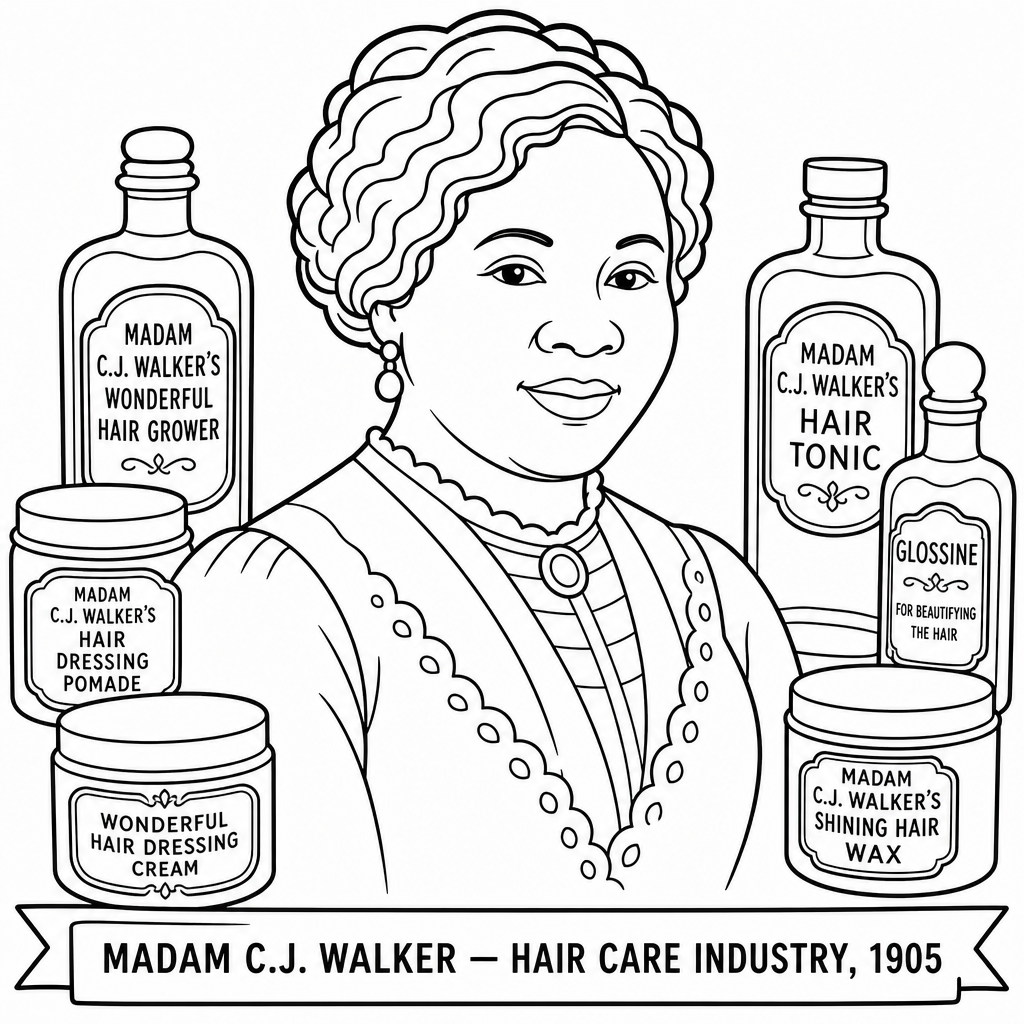
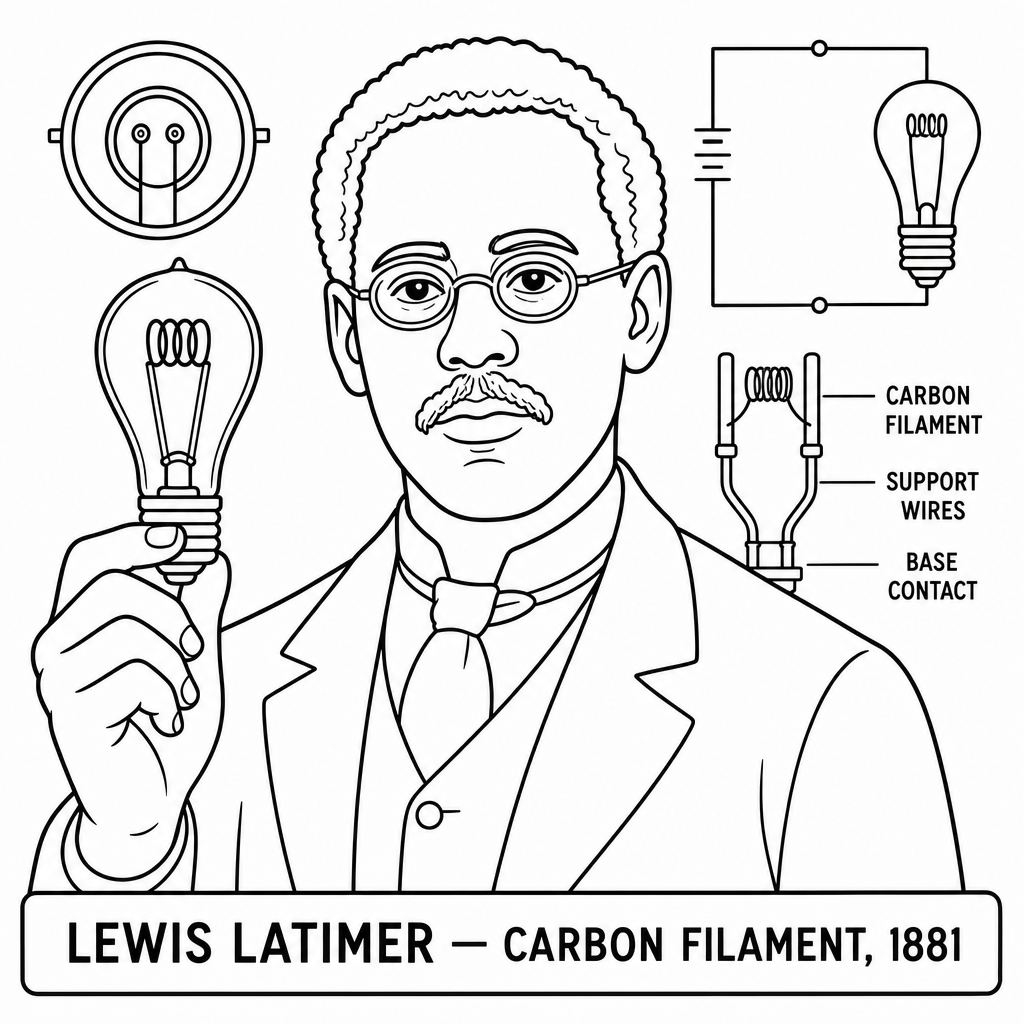
Want a specific king, queen, elder, or Chicago voice added to a future collection? Email raven@hiphopdivinitybrand.com.
The Hub
Educator, school, or source we should add to the Archive?
Submit a Black educator, school, historian, or primary source. Priority to Black publications and scholars.